Polyrhythms, explained
Hear each part, then play them together.
Learn to feel 3:2, count 4:3 and practise 5:4. Listen to each part on its own, then bring them together over one shared cycle.
No theory required. Choose a comfortable tempo and listen to one part at a time.
Hear the relationship.
Start with Both layers. Then isolate the low pulse and add the high part with your hands. Nothing plays until you press Play.
The diagrams and complete lesson work without audio or JavaScript.
● High: 3■ Low: 2
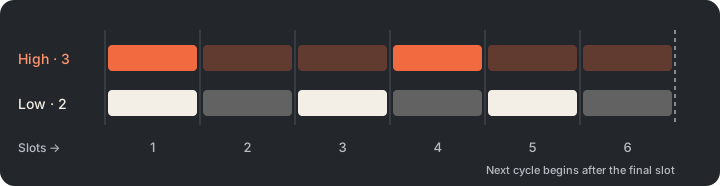
3 high notes and 2 low notes divide the same span. Both cycles start together.
BPM follows the low 2-note layer. One shared cycle takes 2 seconds.
See the counting grid, one slot at a time
What is a polyrhythm?
A polyrhythm combines contrasting rhythmic divisions at the same time. In the examples here, two evenly spaced pulse streams divide one shared span differently: three against two, four against three, and so on.
Imagine two people leaving the same point on a circular track. They take the same time to go around once. One claps three times at equal intervals; the other claps twice at equal intervals. Their claps overlap at the start, separate inside the cycle, and meet again when the next lap begins. That is the basic idea of 3:2.
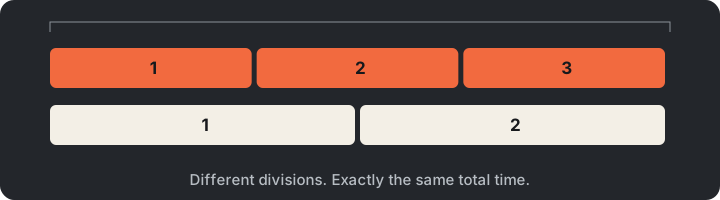
The important word is evenly. Do not rush three notes into the space before the second low note. Each layer must have its own steady spacing all the way through the cycle. The interesting rhythm comes from the relationship between the layers, not from making either one irregular.
What do the numbers mean?
Read 3:2 as “three against two”. The first number names one layer; the second names the reference layer. This is a relationship, not a time signature. In our lab, the low layer is the reference: at 60 BPM, its notes are one second apart. A complete 3:2 cycle therefore lasts two seconds.
A single triplet is a subdivision, not automatically a polyrhythm. You hear the contrasting relationship when it sits against another division of the same span. Nor does “more than one rhythm” mean every busy drum beat is usefully analysed as an equal-pulse ratio. This guide starts with the clearest examples before adding musical context. See the theory references.
How to play a 3:2 polyrhythm
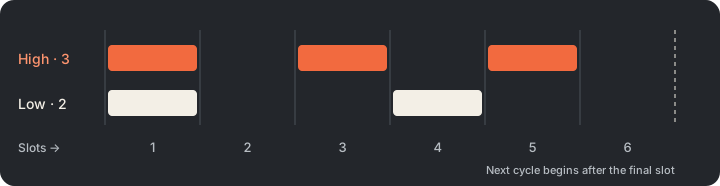
Divide one cycle into six equal slots. Play the three-note layer on 1, 3, 5. Play the two-note layer on 1, 4. Then repeat, keeping every slot the same length.
- Establish two. Choose “Low only” in the lab. Tap your left hand with every low note. Keep the hand relaxed and listen for even space between taps.
- Learn three on its own. Switch to “High only”. Tap the right hand with that layer. It has shorter gaps, but no long-short swing.
- Join at the beginning. Hear both layers. Tap both hands on slot 1, the right on 3, the left on 4, and the right on 5. Leave slots 2 and 6 empty. Repeat just one clean cycle before trying several.
- Stop leaning on the recording. Hear the low layer while you supply the high layer. Then reverse the exercise. Finally switch which hand plays which part.
A mnemonic that actually matches the grid
Place “Hot — cup of tea —” on the six slots. “Hot” is both hands, “cup” is the three-note hand, “of” is the two-note hand, and “tea” is the three-note hand. The words fall on slots 1, 3, 4, 5, not on four equally spaced syllables.
Speaking a phrase casually does not guarantee correct timing. Use it to remember the order of events, then use the grid and audio to learn the spacing. Eventually listen for two independent, even layers rather than one memorised sentence.
A useful checkpoint: play eight comfortable cycles, stop, and start again with the hands reversed. Eight is a practice target, not a scientific threshold. Success means the two-note part stays even while you pay attention to the three-note part.
How to count and play 4:3
A 4:3 polyrhythm fits four evenly spaced notes against three in the same span. Use twelve equal slots: four on 1, 4, 7, 10, three on 1, 5, 9.
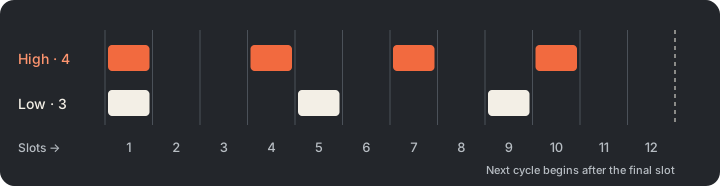
At 60 reference BPM, the three-note low layer takes three seconds to complete the cycle. The high layer plays every three-quarters of a second. It is tempting to move the second high note onto the second low note. Resist that: the high note on slot 4 happens just before the low note on slot 5.
First tap the three-note reference alone. Next hear both layers but play only the four. Finally add the reference with your other hand. Think of the near-neighbours as two separate events, not a flam squeezed into one gesture. Slow enough to hear the separation, but not so slow that you lose the whole shape.
When counting twelve becomes cumbersome, count the three large reference beats and keep the four-note layer even across them. The small grid is scaffolding. You are learning the relationship, not trying to recite twelve numbers forever.
How to learn 5:4 without guessing
A 5:4 polyrhythm places five evenly spaced notes across four reference beats. A twenty-slot grid puts five on 1, 5, 9, 13, 17 and four on 1, 6, 11, 16.
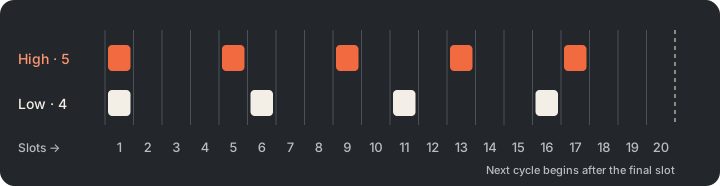
Listen to the five-note part on its own until you can sing it smoothly from one shared downbeat to the next. Now put the four reference beats underneath it. At 60 reference BPM the cycle lasts four seconds, and each gap in the five-note layer lasts 0.8 seconds.
Use the twenty slots to locate a difficult crossing, then return to hearing the whole cycle. Counting every small slot at performance speed usually makes this harder to feel. Try one cycle of five-against-four, followed by one cycle of ordinary four-beat time. Alternating with something familiar gives the unusual phrase somewhere clear to resolve.
The counting method for any ratio
Find the least common multiple of the two counts. That is the smallest number of equal slots that can represent both layers exactly. Divide that number by each layer’s count to find the spacing between its notes.
For 4:3, the least common multiple is 12. Four notes are spaced every 12 ÷ 4 = 3 slots; three notes are spaced every 12 ÷ 3 = 4 slots. We label the first slot 1. The note positions therefore start at 1, not at the interval value.
| Ratio | Grid | High layer | Low reference |
|---|---|---|---|
| 3:2 | 6 | 1, 3, 5 | 1, 4 |
| 4:3 | 12 | 1, 4, 7, 10 | 1, 5, 9 |
| 5:4 | 20 | 1, 5, 9, 13, 17 | 1, 6, 11, 16 |
| 5:3 | 15 | 1, 4, 7, 10, 13 | 1, 6, 11 |
| 7:4 | 28 | 1, 5, 9, 13, 17, 21, 25 | 1, 8, 15, 22 |
Multiplying the two numbers works for the coprime ratios above, but it is not always the smallest grid. For 6:4, use twelve slots rather than twenty-four. The 6:4 relationship contains the simpler 3:2 relationship twice inside the larger stated span. Its layers meet halfway through as well as at the cycle boundary.
More numbers are not automatically more musical. A convincing 3:2 phrase over a steady accompaniment is more useful than an unstable 7:4 exercise. Use 5:3 and 7:4 in the lab as listening challenges after you can hold the reference pulse without chasing the higher notes.
Polyrhythm vs polymeter: hear what changes
In the equal-span polyrhythm demonstrated here, the layers divide the same duration differently. In our shared-pulse polymeter demonstration, the beat duration stays the same but the bars have different numbers of beats.
Polyrhythm · 3:2
Three notes occupy the same duration as two. Their spacing differs. Their complete cycles start together every two reference beats.
Polymeter · 3 and 2
Both voices play the same steady beat. One accents groups of three; the other accents groups of two. Their bar starts meet after six shared beats.
Go to the lab and keep 3:2 selected. Switch “Compare the idea” between the two modes. Listen for different spacing in the first and different accent groups in the second. In a sequencer, stretching three notes to fit a two-beat clip demonstrates the first. Looping a three-beat clip beside a two-beat clip without stretching demonstrates the second.
Real music can combine both ideas, and terminology varies between musical traditions and analyses. Different time signatures alone are not a foolproof diagnostic: ask what happens to the pulse, the grouping and the total span. The lab deliberately isolates one clear model of each.
Three nearby ideas that are not interchangeable
Swing changes the relative duration of notes within a beat, often making a long-short pair. A swing ratio written 3:2 describes durations; it does not by itself mean three evenly spaced notes sounding against two.
Hemiola concerns a three-against-two grouping relationship, often a temporary reinterpretation of the metre. It can unfold successively rather than requiring both layers to sound throughout. Context matters.
Tresillo (3+3+2) divides eight small units into unequal gaps of three, three and two. That is not the same as three evenly spaced notes against two. Likewise, the “3–2” in a 3–2 clave describes the order of the three-stroke and two-stroke sides, not this lesson’s equal-pulse 3:2 ratio.
Put the relationship into something you play
Keep one musical variable simple while learning another. Use one pitch or a muted sound first; add melody, dynamics and articulation once the time relationship is stable. These are original starting exercises, not transcriptions of a particular musical tradition.
Drums
Keep two soft kick notes as the reference and play three light hi-hat notes over the same cycle. Next swap the roles. Leave fills out until neither limb drags the other off its spacing.
Piano
Play two repeated bass notes with the left hand and three repeated treble notes with the right. Introduce a simple three-note melodic shape only after the repeated-note version feels settled.
Guitar or bass
Tap the reference with your foot and play the contrasting layer on one muted string. On fingerstyle guitar, try the reference with your thumb and the other layer with a finger, without adding chord changes yet.
Production
Use two clearly different sounds. Set the clip’s total length first, then distribute each layer evenly across it. Do not confuse an equal-span tuplet pattern with two fixed-grid clips of different lengths.
Let the unfamiliar phrase resolve somewhere audible: the start of a new bar, a chord change or the return of a familiar groove. Polyrhythm is a way to shape tension and release, not a requirement to make every part complicated. Study performances and teaching from the particular tradition you want to understand; a ratio chart is not a substitute for style, phrasing or listening.
A seven-session practice plan
Use five focused minutes per session as a starting point. Repeat a session whenever it still feels unstable; this is a sequence, not a promise that every player will master the material in a week.
- Session 1 · Hear the layers. Listen to each side of 3:2 alone. Clap with each one, then listen to both without trying to play.
- Session 2 · Find the crossings. Use the six-slot grid. Play one correct cycle at a time with both hands.
- Session 3 · Keep the shape. Build up to eight comfortable cycles. Stop and restart rather than recovering from an accidental rush.
- Session 4 · Swap the roles. Reverse the hands, or move the reference to a foot. Keep the tempo unchanged.
- Session 5 · Supply the missing part. Choose “Low only” and play the high layer yourself. Then choose “High only” and supply the low part.
- Session 6 · Make a musical phrase. Apply 3:2 to one instrument. Alternate a polyrhythmic phrase with a simple reference pattern.
- Session 7 · Review, then explore. Record yourself if useful. Listen for even spacing, not just simultaneous starts. Begin 4:3 only when 3:2 is comfortable.
Take the grids to your instrument.
A printable practice sheet with 3:2, 4:3, 5:4 and the seven-session plan. No email wall.
When it falls apart, diagnose one thing
The high notes become uneven: isolate that layer and sing it before playing. The low pulse shifts: lower the high sound in the full trainer or play the reference alone again. The next cycle arrives early: leave the final silent slot its full length. Everything works only at one tempo: change the reference by a small amount and rebuild without tension.
Do not count success by speed alone. Being able to restart, swap roles and maintain a part while the other is silent tells you more about independence than one fast run.
Do you have the relationship clear?
This checks your understanding, not your playing accuracy. No microphone or timing score is involved.
Polyrhythm questions, answered
What is a polyrhythm in simple terms?
A polyrhythm combines contrasting rhythmic divisions at the same time. A useful first example is three evenly spaced notes against two evenly spaced notes over one shared span.
What does 3:2 mean in music?
For this polyrhythm, the first layer plays three evenly spaced notes while the reference layer plays two in the same duration. Read it as “three against two”. It is not a time signature.
What is the easiest polyrhythm to learn?
Start with 3:2. Its six-slot grid puts the three-note layer on slots 1, 3 and 5 and the two-note layer on slots 1 and 4. Learn each layer alone before combining them.
How do I count a 4:3 polyrhythm?
Divide the shared span into twelve equal slots. Play the four-note layer on 1, 4, 7 and 10 and the three-note layer on 1, 5 and 9. Both return to slot 1 of the next cycle.
Are 3:2 and 2:3 the same?
They contain the same pair of pulse rates when the shared span is held constant, but the reference layer changes. In a trainer whose BPM follows the second number, reversing the ratio without changing BPM also changes the length of the shared span.
Are triplets automatically a polyrhythm?
No. Triplets describe one subdivision. A triplet layer heard against a contrasting subdivision, such as two even notes over the same span, creates the familiar three-against-two relationship.
Is 4:2 a polyrhythm?
Usually it is treated as an ordinary subdivision: each of the two pulses divides neatly into two of the four. Different numbers alone do not establish the contrasting division normally meant by polyrhythm.
Do I need two hands or an instrument?
No. You can clap with a recorded reference, sing one layer while tapping another, or use one hand and one foot. Two hands are simply a convenient way to practise both layers yourself.
What BPM should I use?
Try 60 BPM on the reference layer, not on every tiny counting slot. In this lab, 3:2 then takes two seconds per shared cycle. Choose a pace at which you can keep both layers even without tensing up.
Why do I lose it when the reference is muted?
You may be following the sound without yet maintaining its pulse internally. Reduce the challenge: keep one layer playing, add the other for a single cycle, then try a short muted section. Return to the reference to check alignment.
References and lesson notes
This lesson focuses on equal-pulse relationships as a practical starting point. Musical usage is broader. The grids and synthesized listening examples are original and use the same timing model.
Steps to Music Theory: Advanced Rhythm and Meter, hosted by Texas A&M University Libraries, provides further discussion of polyrhythm, polymeter and hemiola. Open Music Theory: Swing Rhythms explains why swing is not simply the equal-pulse exercise taught here. Soundbrenner’s 2:3 lesson offers another practical treatment of the two-against-three relationship.
Lesson and diagrams: SuperTime Ultra. Substantively revised .